-
The Saint of Imagined Communities
The Saint of Bright Doors is a phenomenal book I read long enough ago to have forgotten most of the detail. What remains is a semi-digested slurry of images and emotions, and I can highly recommend them. If you haven’t read it, please know that the rest of this post will be more or less incomprehensible.
When I ask casual readers, that is to say, readers who aren’t read to learn to write, about their opinion of this book, the reviews are largely positive. The main complaint I hear from them is that the adventures that Fetter, our protagonist, wanders into seem arbitrary and pointless.
To me this complaint is, plainly speaking, accurate. The book is heavy on the vibes and prose, and all the adventures Fetter goes on seem episodic to the point of incoherence. Now let me tell you why that’s a good thing. (I’m sure there is an official reason for this choice by Vajra, but Barthes told me he’s dead now so I can’t ask him and am forced to guess.)
Vajra is trying to build up this city/nation of Luriat through what I recently learned is called a tour d’horizon, a journey to the bounds of the known world. This would be a banal exercise in taxonomy, except I picked up that term in an unexpected source.
For reasons unknown to gxd and mxn, I subjected myself to Benedict Anderson’s Imagined Communities late last year. Though there is a sustained critique of Anderson by post-colonial scholars, I found his claim that nations were imagined into being through print capitalism fairly interesting. (It’s possible that’s not the claim and I’m misreading it. If so, sorry. I’m an engineer. Leave me alone.)
In focusing on print capitalism as a form of nation-creation, Anderson briefly cites scholarship on El Periquillo Sarniento, a picaresque critique of Spanish colonialism in Mexcio to note that the hero’s journey through the hospitals, prisons, remote villages, monasteries of Mexico “conjure up a social space full of comparable prisons, none in itself of any unique importance, but all representative (in their simultaneous, separate existence) of the oppressiveness of this colony.”
If you have read The Saint of Bright Doors, this list of places above seems almost too neat. At some point in the book, Fetter stops by almost all of these settings, highlighting how they contribute to the oppression of the common public. I think this is intentional through conscious choice or revelatory through happy coincience. I think Saint is a tour d’horizon for a made-up world that is also Sri Lanka, written to induce in the reader a familiarity with the city/nation of Luriat in which you can see reflected the nation/state of Sri Lanka and its struggles with power.
Overall, I would say this is the kind of risk I don’t take in my own writing. This could easily been an excruciating slog leading from, through, and to nothing, but the prose and the density of commentary in each location end up carrying the book / 10
-
No think. Only do.
I don’t know anything about Daoism except that Ursula K LeGuin thought it was cool and good.
This is relevant because I just finished China Mountain Zhang by Maureen F. McHugh, a 1992 alt-history about an American-born Chinese man in a unipolar world where Socialism (with Chinese Characteristics) appears to be hegemonic.
I first heard about the book in one of Zachary Gillian’s bluesky posts and bought it immediately because that man knows ball. It went into my DNF pile after I ran into an uncomfortable amount of slurs in chapter one. Then I heard glowing praise about it several times from Patrick Nielsen Hayden at Viable Paradise, and decided to pick it up again.
Hate when something I want to hate is actually extremely good.
The slurs really weren’t necessary, and it needs a massive trigger warning slapped across one of its chapters, but it is one of the finest books I’ve read in a long time.
In summary, the novel covers ten years of Zhang’s life as he moves between New York, China, and Canada, with occasional diversions into other lives that touch his. McHugh uses these stories of mostly marginalized people to sketch out a world with a wild alt-history, peculiar social norms, and novel technologies. Readers more attuned to actual Chinese culture (or Chinese-American culture) will have more to say about this book than I could (both positive and negative) but as an outsider to both these cultures (USAmerican and Chinese), I was fascinated.
The prose is invisible and the characters are irresistible to follow. Zhang’s miserable lavender date in chapter one alone is well worth the price of the book. Her skill with Man vs The Man plots is staggering, especially how she personifies the wielders and victims of the systems that govern her alt-Earth. It’s very engaging, to the point that I now have opinions (probably wrong ones) about Martian council processes and Daoist engineering principles.
Speaking once again of Daoism, the title of this post is how I understood the book’s interpretation of the Dao, specifically of wu-wei, the Daoist concept of non-doing. As a non-expert, it sounds to me like wu-wei refers to doing without analyzing, allowing experience to lead to outcomes without the mind getting in the way.
It’s an interesting counterpoint to a tendency I see in my own reading nowadays, that of trying to reverse engineer why something works. Trying to work on on my craft has turned me into a “no do only think” nerd when it comes to reading, almost the anti-thesis of the Dao.
Someone recently said to me that a good book teaches you how to read it. If China Mountain Zhang is a book about the Dao, then it certainly taught me how to read it. A few chapters in, I disappeared into McHugh’s world and writing, re-entering the mode of “no think only do” after a very, very long time. Cannot recommend it highly enough.
TLDR: China Mountain Zhang good. Look up trigger warnings. Remember it’s from 1992. Please correct me if you’re culturally Chinese.
-
Pod Escapades
I started as an Associate Editor at Escape Pod on September 15th and have read around 50 slush pile stories since. I’d say more but I’m actually not sure how much more I’m allowed to say about the stories themselves. Will ask the Assistant Editors if I can say more about it, because I’m absolutely dying to say more about it.
I’ve also started querying The Novel*, which is an exercise in masochism that short story rejections DO NOT prepare you for. It’s one thing to spend a few weeks (months?) polishing a short story to have it rejected, but it’s another to spend months (years?) laboring over wordcounts that are unsuitable for polite society, only to not even receive a response.
Between this, work being what it is, and maybe having to move continents, blog neglect seems quite justified.
* The Novel refers to the current completed novel. The novel may be, but should not be pre-emptively confused with, The Novel, i.e. the work that will make all this work worth it, or The Novel, i.e. the novel after which I will give up and return to short story land. The Novel is general, particular, diffuse, perfectly spherical, frictionless, expansive, subject to the Navier-Stokes equations, and also entirely biodynamic. The Novel is The Novel.**
** As you can see, The Novel is making me lose my fucking mind.
-
Giant Chips, Giant Shoulders
I’ve been reading more short fiction to try and understand where the market is today. When people hear this, many tell me this is a Bad Thing for writers to do. From seasoned pros to random relatives to people in my writing group, there seems to be no dearth of people who believe creative work should appear ex nihilo from the genius artist’s brow. I don’t think I can agree with this.
To me, writing feels like a conversation with past works. Everything I write is the meeting minutes of my own imagined salon starring Pratchett, Roy, Erikson, and so on. Newer writers (Jemisin, Ha, Chiang) also chip in, usually with more interesting and current suggestions. I don’t think I can write if I don’t read.
Maybe it’s a Me Problem. I’m an engineer who grew up in the STEM-lord hegemony of post-90s India. I always feel behind on reading compared to my peers. I’m hesitant to even call them my peers. In one sense, I’m ahead of them in that my intuitions on physics and causal inference are stronger than many active writers. In a much more important sense, I’m far behind them; my impoverished intracranial salon is significantly more parochial than someone who grew up reading The Canon or someone who works in Real Science (TM)(C)(R) and can summon cutting edge speculation at the drop of a pipette.
It’s also possible that those complaining about my reading approach are pointing to a different problem: they’re worried I’ll get stuck trend-chasing. People who believe this are unaware of how much work it would be for me to actually accomplish this. I don’t have the skills or fortitude needed to (a) identify a market trend (b) translate that into a story outline and, (c)rucially, actually write a story that I’m not interested in on its own merits.
“Understanding the market” is just me trying to understand what I’m stepping into, so I know what I’m in conversation with. Imagine I sat down to write a story set in the impact of LLMs on creativity without knowing that Thomas Ha already wrote a great story about that (The Mub.) Whatever I could come up with might be an interesting story, but it would also be a shallower one.
There’s a perverse similarity between the people telling me to avoid marketomancy, and the people who (incorrectly) defend LLMs as extensions of this behavior. Though the former would vehemently deny this connection, both approaches treat writing as a coin-operated machine: insert ideas here, just add terajoules. This is also, ironically, STEM-lord logic. The mental model of writing as a conversation is much more interesting to me, and has the added benefit of being more human.
The final irony of this formulation is that treating writing as a conversation is already common wisdom in a particular set of fields: science, technology, engineering, and mathematics. The nerds who built those LLMs didn’t also invent calculus from scratch. And I shouldn’t have to invent multi-POV short stories to know that they’re an option. We all stand on the shoulders of giants.
Now that I have used the STEM-lord in me to defeat the STEM-lordism in my well-wishers, I will now return to my stories. Because, and this may be the most important part, I LIKE TO READ.
-
Where I’ve been
Not that anyone’s been clamoring for updates, but I’ve been working double time at work and writing, and now I have the third draft of my WIP novel ready to ship.
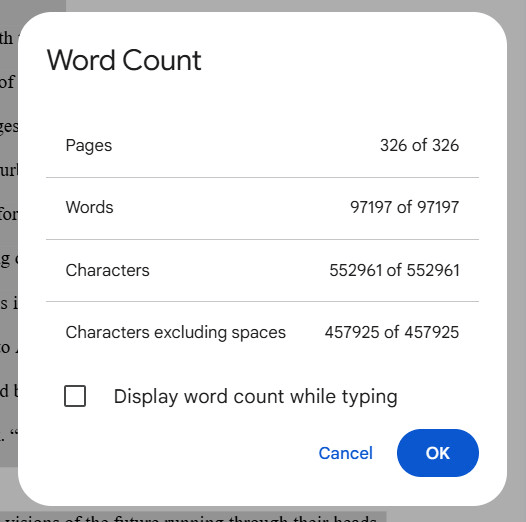
This took me ~6 months total, but with a final sprint of 3 months in which I rewrote and edited THE WHOLE THING. Slightly over a thousand words a day.
I know you’re supposed to keep a “writing a novel” blog but goddamn if I was going to write more than I absolutely had to while keeping that pace. Instead, here’s a wrap-up of my three biggest takeaways
- Doing hard things is fun for me after the hard thing is done
- Don’t do this hard thing at the same time as a full time job, an ongoing house renovation, and an attempt to take up running
- This could not have happened without my wife pushing and supporting me throughout this time (and all the time before this)(Hi, I know you’re reading this. Love you!)
Now I just need to edit again and then… find an agent to find a publisher to find an audience that might find this weird book about cooking, automation, and India interesting
…
I may need to print takeaway #1 on my desk.
-
Dems in Soup as Egg Prices Drop
Editorial Desk
WASHINGTON: the Institute for Economic Freedom’s (IEF) latest report on consumer pricing shows that egg prices have fallen since January, from $12.99 a dozen to $3.99 per egg, leaving the Democrats scrambling for a new midterm strategy.
Dr. Richard Spencer (no relation) XIV, the IEF’s Distinguished Fellow for the Study of Post-Malthusian Hygienics described the trends as follows: “our models predict the egg price curve will invert within the year, with prices heading into negative territory. That’s right. The prices for eggs will be below zero by the end of the year.”
Speaking about the reasons behind this surprising drop, the erudite Dr. Spencer had this to say: “the drop is causally linkable to macroeconomic stimuli underpinned by the quasi-Pigouvian effects of hyper-targeted tariffs on domestic supply polynomials, and the amelioration of deadweight loss subsequent to industrial policy failures of the Biden regime.”
When asked how the Republican admin’s outreach to the average voter would cover this complex chain of reasoning, Dr. Spencer scoffed and said, “What are they, Democrats? They can just print bumper stickers saying ‘free eggs, free money.’”
An inversion of the egg pricing curve would be unprecedented since 2008’s financial crisis led to the first unprecedented egg curve inversion in recorded history since the 2002 dot com bubble.
Despite these unprecedented circumstances, Dr. Spencer assured us in a firm voice that reminded us of our fathers, that there is no need to worry about any white mountains of discarded eggs filling with wrath growing heavy, growing heavy for a harvest. Per the good and handsome doctor, “Our most robust models also predict that these concerns are unfounded. The outlook is sunny.”
On the beltway, the Democrat messaging strategy around egg prices has had a great fall, and despite all their horses and men, they’re unable to put it back together again. Instead, Dem leadership has deployed deep state proxies from their think tank industrial complex, such as the Media Overview Committee (MOC), which The Washingtonne Post (no relation) recently found to be collaborating with China, Hamas and East Timor.
Sam Bankman (no relation) from the MOC shares this anecdote in his confused response to the IEF’s hardboiled analysis: “Hurr durr the egg prices have gone up. D’doiiii just go to a f—ing grocery store, hello? Hurrrr there’s an epidemic of bird flu! Duhhhhh most of the shelves are f—ing empty! Durrrrrr.” (edited for clarity.) The Post’s independent fact-checking team found that these debunked reports of rising egg prices and bird flu originate from disinformation networks operated by the Ukrainian government.

Featured image: Nils Rohwer, 2010
[Updated 3rd March, 2025: while there is no record of consumers being paid to receive eggs during 2008, the Post’s fact-checker team found that the models employed by the IEF do show negative prices during both 2002 and 2008. Mr. P. Freely of Portland, Maine has been awarded Four Pinocchionos for his failed fact check, and a team has been dispatched to his last known whereabouts.]
[Updated 4th March, 2025: you can buy the aforementioned bumper stickers at http://www.free-eggs-free-money.com. Enter the code MSGA for a 47% discount]
-
Unperson
Neil Gaiman is most likely a monster, as we have all heard by now (trigger warnings.) The main story here is the bravery and well-being of the women who dared testify about this immensely popular author in the public eye.
My feelings about these revelations are meaningless in comparison. However, compounded across the millions of people touched by Gaiman’s work, even the minor harm per former fan aggregates into something worth addressing. Distinct from and far lesser than the harm (allegedly, but credibly) inflicted on the women who spoke up, it still exists. And I don’t know what to make of it.
These are all questions that have become familiar by now, with the key one being: what comes next? As with Polanski, Louis CK, Woody Allen and many more, I want to know what to do with the love I once held for Gaiman’s works. Do I exorcise my shelf by throwing away all copies of his novels and comics? Or do I bury them under the floorboards? Burn them as effigy? Do I tear Good Omens down the middle?
Nobody really seems to know. When I ask these questions of people with their heads screwed on tight, they usually diagnose me with a case of idolatry, going on to prescribe that I discard this parasocial attachment and any aspirations of a moral celebrity. They explain that expecting moral perfection from anyone is a losing bet, so why hold artists to these standards? Why agonize over the morality of a creator? Why care about their actions? Why not let the art speak for itself? I appreciate the thoughts behind this diagnosis but it doesn’t help me. Unlike the legions of former adoring fans grappling with monstrous idols, I have no difficulties discarding Gaiman himself.
American Gods is a different problem. Gaiman’s 2001 novel was formative for me as a writer. Past and present me often disagree on matters of taste, so the book may not have aged well even outside of its author’s crimes (alleged, but credible.) Even so, that doesn’t erase the book’s profound influence on me. Even though I will never again read the book again, repulsed by its association with Gaiman’s alleged (but credible) monstrosity, this rejection wouldn’t change the evenings I spent sprawled on my cot in Bangalore, my legs up against the wall, leafing through my second hand paperback. Nothing will un-write the Mr. Ibis fanfictions I turned in for creative writing contests and nothing will un-recommend that book to the hundreds of patient, glassy-eyed men and women who met me in the 2010s. The book is indelibly part of my past, and so I want to explore what I can do about American Gods.
Claire Dederer’s 2017 article What Do We Do with the Art of Monstrous Men is often referenced as a starting point for such inquiries, and I can see why. In this deeply personal piece, Dederer traces the evolution of her feelings about Woody Allen’s oeuvre, beginning at an initial enamorment and passing through post-exposé disgust, only to culminate in a begrudging, tentative reacceptance of Allen’s art, though not of Allen the artist. Of interest to my problem, even in this final phase of indulgence, Dederer can’t bring herself to accept Manhattan, the movie where Allen’s script coincides most closely with his crimes. Though she steadfastly opposes universalizing her own experience, I can use this difference between Annie Hall and Manhattan and Dederer’s own direction in the piece to sketch the outline of an answer that appears satisfying: the path forward can only be a personal one, one where your own moral feelings about individual pieces of art guide you. For Dederer, this is a path where Annie Hall is acceptable, but Manhattan isn’t. In short, she offers a cogent, emotional defense of separating the artist and art where possible (Annie Hall), while allowing that it might be impossible in some cases (Manhattan.) A pick-and-choose art-minus-artist, appealing in its simplicity.
My experience, or perhaps my perspective, departs from Dederer’s perspective in one key aspect. She appears content to never rewatch Manhattan or, at least, doesn’t appear upset about the loss. I’m not as equanimous about American Gods. I want retribution. I want a proportional and appropriate punishment for Gaimain for the (alleged, but credible) crime poisoning parts of my past. Whatever the legal system does or, sadly and more likely, does not do to Gaiman for the tangible harms he has (allegedly, but credibly so) inflicted on these women, he will remain indelibly attached to American Gods, as well as The Sandman, Good Omens, and The Doctor’s Wife. People like me will have to choose between severing a part of ourselves or becoming complicit in Gaiman’s legacy as a literary giant. The only escape from this choice is to somehow make it so that American Gods has nothing to do with Gaiman, and never had anything to do with him. Perhaps we wipe Gaiman from the record and claim it was plucked from a Borgesian Babel, as if the book itself was a virginally birthed, American god.
Fantastical as this seems, it isn’t without precedent. Even today, many people are only famous for never existing. Nikola Yezhov, the former leader of the Soviet secret police, is one of them. There is a famous photo of Yezhov strolling along the banks of the Volga river alongside Stalin and other Soviet luminaries. In this photo, Yezhov wears a pleased smile, one that shouldn’t rest as lightly as it does, for Yezhov, too, was a monster. In the year the photo was taken, Yezhov led a campaign of arrests, torture, and executions all across the USSR, transporting hundreds of thousands into camps or the afterlife. In modern times, we expect such monstrosity to go unpunished but, happily, this tale ends with comeuppance. Shortly after the purges abated, Yezhov fell afoul of Stalinist court politics, was put on mock trial for crimes during the purge, and was executed. At some point after this belated end to a horrific career, the Soviet press took the photo by the Volga and airbrushed Yezhov out, systematically erasing him from the public record, unpersoning this monstrous man.
For all the USSR’s missteps, this anecdote has a whiff of parable around it. Could you invent a worse punishment for an artist, a being that exists to create and be heard? Is there a more poetic way for me to punish the poisoner of my memories than by erasing all memory of him? A capital punishment for a capital crime.
If we agree this is a fitting punishment, I must next ask: how can I do it? Turning to history for instruction, we find a new name for this practice: damnatio memoriae (lit. the damnation of memory.) The oldest example we find is of the slave Herostratus, sentenced to damnatio memoriae in the 4th century BCE by the Ephesians, for his alleged torching of the Temple of Artemis. Taking the cases of Herostratus and Yezhov together, we can see what is needed to accomplish an unpersoning. Whether Greek, or Mesopotamian, or Irish, or Soviet, an unpersoning can only be attempted by a coordinated exercise of far-reaching power: in other words, the power of a state. Yezhov couldn’t have been unpersoned by a stray apparatchik, nor could a passing helot have damned Herostratus. A corollary of this, of course, is that I can’t erase one of the most prolific and recognizable writers today. Whatever retribution I seek must lie within my own sphere of power, a sphere far tinier than a state, being approximately Abhijeet-sized and Abhijeet-shaped.
Let’s say, for a moment, that I do have the power to attempt this unpersoning, should I expect it to succeed? After all, I can’t ignore that both these attempted unpersonings were spectacular failures. Though this is trite enough to be cliche, it’s worth noting that I only know of Yezhov and Herostratus because of the attempted erasure. There is no other Earthly reason for me to have even heard of those names.
So does that mean all hope is lost? Happily, no! As the historians who study damnatio memoriae note, the goal of this practice often wasn’t obliteration, but condemnation. For example, while human memory still remembers Herostratus, it is not as a husband or father or son, or even as a slave. Herostratus is remembered a sinner, an alleged criminal who burned down the Temple of Artemis, one of the seven wonders of antiquity. The hope isn’t in attempted erasures, but in condemnation.
You might assume condemnation requires the same, vast state power as erasure, but erasure requires a vast conspiracy of silence to be maintained across all of time and recorded history, while condemnation requires only one loud voice. While attempted unpersonings are beyond most individual people’s reach, condemnation isn’t, and it appears to be more effective as well. As it turns out, Dederer was right for me after all. Returning to her instinctive reliance on the personal, I can now synthesize a path forward for me.
Without trying to answer the impossibly complex question of what We, The People should do, I can resolve the far more tractable conundrum of what I, An Abhijeet, can do. Through this tangle of possibility and feasibility and acceptability, only one solution stands out to me. Happily, it is a regression to the mean, in both senses of the word.
The answer for me is to become a hater, that is, a vocal, prejudiced and unfair critic of Gaiman, the kind of person who brings up these allegations in all conversations about Gaiman, the kind of person that replaces “Brock Turner” with “the Rapist Brock Turner” all the time, the kind of person that makes art-artist-separationeers roll their eyes. This seems like the only proportionate and possible retribution against monsters who poison their own art.
Unlike the doomed nature of erasure, being a hater is driven by hope: the hope that, if I do this for long enough, around enough people, with enough clarity, and without being off-putting, the monsters behind my poisoned memories will be seen by everyone as monstrous and nothing more; the hope that, eventually, I will contribute toward tarnishing their legacy, just as they have tarnished my past; that all their achievements will bear an asterisk: Chinatown, by Polanski the
auteur pedophile. The Persistence of Memory, by Dali thesurrealistFrancoist. And American Gods, written by Neil Gaiman, the credibly alleged rapist.As this isn’t about what We The People should do, I won’t be advocating for what you should do, but it sure would be cool and good if everyone did do this. If nothing else, I hope this helps explain if I’m being a hater in the future about Gaiman or Louis CK or Rowling etcetera. And, for that matter, if you find someone going off about the latest monster that has retroactively poisoned their minds, it might be worth cutting them some slack. There’s a non-zero chance they may simply be seeking justice in small ways for small wounds.
-
Writing Online
Cynthia Pelayo ran a pitch contest on BlueSky earlier today, so I took a crack at a pitch for Annapoorna
Not sure it’ll count for anything, but it was a good workout of the pitching muscle, a good excuse to dust off the wacom, and most importantly, a good time.
Rejected pitches for various reasons:
- “Techbro dipshit tries to solve society while dealing with parent-child drama. Definitely not a memoir unless you squint (hard enough to see the past) #A #SF #2025pit”
- “What if you never had to cook again? No, not the Doordash Discourse. Log off. #A #SF #2025pit”
- “I declare that anything posted on BlueSky is my personal property and cannot be used by anyone without my explicit permission. Mohan’s company sends him to India to test a robo-kitchen on the gated community he’s been running from all his life. Now, he must confront caste, class, & gender for the first time, getting everyone to “never cook again!” to save his job, visa and the life he’s built for himself #A #SF #2025pit”
- “Interstellar Megachef + my 20s if I was sober + meal prep + Quarterlife + Player Piano + daddy/mommy issues #A #SF #2025pit”
- “Please pick this up I write goodly and am nice also, usually #A #SF #2025pit”
In other news, NYCmidnight is currently going on, and I should be writing. By Saturday night, I have to turn in a 2.5k word romance about first impressions featuring a devil’s advocate character. TLDR; probably not making it to the next round.
-
Nativist Samosas
[JUMP TO RECIPE]
There’s a shop at the corner of Ryan School Road and Kundanahalli main road in Bengaluru that sells North Indian style samosas with fried chillies and sweet-ish tea begging for a cigarette. When I worked in one of the Bangalore data mines in the 2010s, that shop’s samosas were my substitute for learning to cook.
Today, I found myself thinking about that samosa after seeing a theory online about how wheat is an American conspiracy to make Indians fat. Firstly, because samosas are very dependent on wheat but also because if Indians decide to shun wheat as foreign import, that could suggest some very interesting alterations to the samosas. I asked myself: what would it look like to make a samosa that was purely Indian, of ingredients and techniques verifiably originating within the Indian subcontinent? And so, I set out to decolonize the samosa.
Before we embark on this very important journey, let’s get on the same page about what a samosa is by taking one of these golden tetrahedrons and pulling it apart to investigate. What do we find? A fried casing of maida (milled wheat flour) and ajwain (caraway) holding a mash of aaloo (potatoes) and matar (green peas) spiced with hari mirchi (green chilli peppers), jeera (cumin), dhania (coriander), saunf (fennel), adrak (ginger), heeng (asafoetida), and garam masala (a mix of warm spices.) From a Eurocentric view of food topology, we can now state that a samosa is a spiced-potato-mash-stuffed fried calzone. In the decolonizing spirit, let us invert that gaze and posit that calzones are cheese-stuffed baked samosas.
Now that we hold the same samosa in our minds, let us return to the task of improving it for the nativist palate. We will first run through the ingredients and exclude the ones ones originating outside the Indian subcontinent (for simplicity, the countries contiguous with modern India, except China)
- Potatoes and Chillies: originated in the New World and were introduced in the 16th century by the Portuguese after the Columbian Exchange. Not from here. Denied.
- Peas and Caraway: came to India real early (Indus-era early, i.e. ~5000 BC) but originated somewhere in Anatolia. Go back to Turkey.
- Maida: wheat came to India from the Levant, also during the Indus era. The process of milling is also ancient, but it’s shockingly hard to find a date on when we started getting the bran out of wheat flour. Probably when Norman Borlaug ensnared Indira Gandhi in his web of international wheat schemes. Basically a Soros conspiracy.
- Asafoetida: the deserts of Iran and Afghanistan. Afghanistan might count, given our loosey-goosey definition of Indian subcontinent.
- Cumin: originated in the Middle East. Need I say more?
- Coriander and fennel: the Mediterranean coastline. Arrivederci, amico. Adio. Güle güle.
- Ginger and most spices in garam masala: Southeast Asia. The Chola thalassocracy might nudge this over into acceptability eventually but, for now: selamat tinggal!
- The other spices in garam masala: Black pepper, cardamom and (maybe) cinnamon are all from the Indian subcontinent. Desh ki dharti plus solemn tear.
Now that we’re done with the ingredients. Let’s consider the two key techniques
- Stuffed pastry-packet: Given that wheat itself isn’t from the Indian subcontinent, this may not be relevant but I found it interesting that the casing technique and the name itself might not be acceptable to a nativist. Sambusas or a sambusak or qutab (no relation, presumably) probably came from the Middle East, as narrated by Amir Khusro (yes relation, same guy) when he described the Delhi Sultanate’s courtly foods.
- Frying: the concept of frying finds first mention fairly early on in Indian history, with Harappan ruins revealing copper frying pans and the Rigveda mentioning many instances of frying. I am not going to even accidentally imply that those two aren’t Indian, because DDoS attacks are no joke.
The food historian Pushpesh Pant also notes several claims that samosas is actually Indian based on references to a dish called samushak in Sanskrit texts. However, knowing when potatoes came to India, it would be implausible to imagine that the potato-filled samosa is any older than the 16th century. Now, is a samosa with no potatoes in it a samosa at all? The answer is left up to the reader, with apologies to Lalu Prasad Yadav. For bonus comedy, try and guess how many less polite phrases I went through before landing on “implausible.”
Given everything we have learned about the nativist samosa, we can now reconstruct a recipe with ingredients and techniques authentic to the Indian subcontinent. Here you go, dear reader, the fruits of our labor:
Nativist Samosas
[PRINT] [SAVE] [RE-EVALUATE LIFE]
Calories: 0 kcal per serving
Serves: you right
Ingredients
- 1 tsp nativist garam masala (ground up black pepper, cardamom, cinammon)
- 1 pinch of asafoetida
- 4 cups of frying fat (oil, ghee, tallow etc.)
- Salt to taste
Steps
- Line a plate with a paper napkin
- Heat 4 cups frying fat in a heavy bottom pan till it reaches 350F/175C
- Add the nativist garam masala (watch for splatters) and salt to taste
- Add the asafoetida and immediately go to the next step
- Work quickly with a spoon to remove the powder onto the napkin
- You can lick the napkin, or scrape off into a serving dish
- Bon appetit!
-
Launch
Given that it’s a new(ish) year, I’ve been trying to write non-fiction for a while, and I’ve started reviewing ARCs on NetGalley, this is as good a time as any to kick off a website. And the best way to start anything is by making an unnecessary explanatory post, just like every blog I’ve started since good god look at the year.
In brief, here are my goals with this website. First and foremost, this is my writer website, which I have also been putting off for a year or so. Second is the blog section, which will hold reviews of whatever I’m reading, non-fiction about any hyperfixations, and updates on any data side projects. And last, it’s to post art as and when I make it.
It’s a weird time to become more online, personally, professionally, and also just zeitgeistically. Still, can’t hurt to try. I’ve always wanted to write more non-fiction. Maybe someone will want to read it, too. In the worst case, at least I have a non-linktree link to point people to for all my writing.
-
Subscribe
Subscribed
Already have a WordPress.com account? Log in now.
 Abhijeet Makes Things